
home

our books

a-z

ordering

contact us

search

links

news

Steve Savage Publishers Ltd
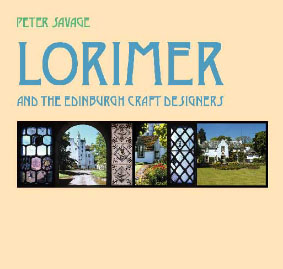
CoverLorimer

and the Edinburgh Craft Designers

Peter Savage
sample extract...

The fourth perspective in The Builder showed a design for a manse at West Wemyss. The coastal plain of Fife is dotted with small towns and for this more domestic landscape Lorimer chose a traditionally common L shaped block, its simple mass only enlivened by its details. The caption to the group of drawings read: 'These modern Scottish houses built in the local style illustrate the principle of employing in all cases local material and local workmanship and thus producing houses characteristic of a stonebuilding district.' The words were either Lorimer's or the editor's paraphrase of them.

It may seem contrary of Lorimer to have used harling to express the qualities of stone, yet experience of using granite in random rubble walls, in Aberdeenshire in particular, has shown that harling is the only way to make them weather tight in exposed situations. The granite being entirely impermeable, water begins to run down any granite wall face in all but the slightest of showers, while a wind will push the water through the slightest fissures in it, and it is no accident that harling came to be widely used in Scotland. It so happened, also, that a fashion for white walls adopted by Lorimer's contemporaries like Ernest Newton occasionally, or by art nouveau architects like Voysey universally, brought Lorimer's houses additional attention and Heathcote Statham, the editor of The Builder, in writing a book on modern houses two years later, remarked that Lorimer's designs had 'attracted a good deal of attention and admiration among the more artistic section of architects'.

The designs were noteworthy for their fine sense of proportion and careful massing and this publicity established Lorimer as an up-and-coming Arts and Crafts designer of cottages derived from the vernacular. He had returned from London imbued with the ideals of William Morris and with the example of George Bodley, best known for his churches, whose success was due no more to his sensitive design than to his careful orchestration of his artists and craftsmen. The structural possibilities of any church in the Gothic offer wider opportunities for practising the great gospel of materials than a house, yet from his first days in practice Lorimer had found opportunities for the craftsmen who were to work with him, in many cases, for the rest of his life. Sam Wilson and Thomas Beattie were moulding enriched ceilings for him within his first year in practice and the Clow brothers, according to Hussey, had begun wood carving for him. They became as imbued with the spirit of the old work as he was, and, like him, they took holidays in Europe to sketch and to visit museums. Lorimer wrote in 1896 of spending, 'a few hours cooling one's hands in the grey twilight of Gothic things in Amiens', the first of many such references in his letters.

His flrst Gothic job was remodelling the Chapel of Wemyss Castle in Fife. He told Dods now back in Australia, 'I was at Wemyss today and it always affects me the same as Earlshall. I want to be left alone to dream and dream by the hour about the "right kind of stuff to do and the right kind of life to live" as you put it. There was nobody there today and after looking over the stonework of my chapel which is really not going to look so bad, a good Norman crypt, I went and strolled about the delicious rooms. It's not that there's anything wonderful about them but they have an atmosphere. Something you can't describe and that a mug can't feel, that you feel yourself thinking, you don't know why, about everything that is most precious in life and design, fancy that has taken fair shapes, children's laughter and the never to be discovered girl. The ideal life in the ideal old, traditional "un-hurrying" Scotland, and outside right below the windows, the great sad moving sea, and ships tacking for the Baltic. I think it's the sea that does it, and then you feel that you simply must keep on doing things your way, and that please God, if you don't altogether lose the place, that you may perhaps someday produce one or two jobs that have the "little more" about them, that to have done would be to have done something, but that if one allows oneself to be drawn into the ordinary rush of things, when you have the other temperament, you'd make life a simple hell for yourself.'

His letters tell of the artists he was using. Phoebe Traquair, a painter and enamellist, had been staying at Kellie, 'I don't think I know anyone who is as sympathetic to me artistically. She's so sane, such a lover of simplicity, and the things that give real lasting pleasure are the simplest things of nature. The singing of birds, the bleating of sheep in the distance, morning and evening, everything and everyone she finds interesting and all this without a trace of self consciousness!' Louis Davis, the stained glass artisr from London, came to stay at lkellie soon after. 'He's a ripper, a chap of about 40 but as keen as a boy. Such a lovable chap, he and I became great pals at Oxford last year', and 'he's going to do my altar piece at Wemyss and I wired to him to try to get on the job while Randolph is still keen about it. And Phoebe is going to paint a series of fourteen station of the Cross probably. Going to do a sample one first, and she and I devised such a nice piece on Sunday, comme ça .... a spray with a wee crown worked in at the top ... Iast week we arranged a shrine to our Lady. It's in a deep recess there in at one side', and, 'on the other side there's to be an altar to Saint Margaret of Scotland'. The altar was to be a stone shelf supported by 'one twisty column without cap or base! Oh, we're a going of it.'

This early work is not so well integrated as his later Gothic work but this same letter comments on the theme which is central to all his work, the sense of place. 'The other day I started what I really think is rather a "romantic" idea. You know the house [Wemyss Castle] stands on a great cliff over the sea. Well, up to now they've never had access down to the beach but he's now devised a steep stair and then a steep winding path with a few steps there and here, down to the sea, this is to be the way for the public and what we're going to do is this, out of the face of God's solid rock, we're going to carve a niche with a figure of the titular saint, "St Mary Star of the Sea", I'd trouble your early Christians to beat that. Talbot is doing a large silver panel to be let into the window jamb with an inscription Randolph wrote and the full title of the chapel is "St Mary Star of the Sea at Wemyss" on the panel in raised letters with a simple border round of ... good old square flowers' set between, 'two little beads, nice to hear of a fresh idea like that, isn't it?'